Employer feedback provides an important basis for assessing how well programme learning outcomes align with workplace requirements. In accounting, changes in regulations, digital technology and management systems mean that graduates need not only subject knowledge but also practical skills, data-handling abilities and the capacity to work with others. The Faculty of Finance and Accounting 1 at the Posts and Telecommunications Institute of Technology (PTIT) therefore places importance on gathering employers’ views when reviewing its curriculum.

PTIT – MISA cooperation signing
Employer Feedback Helps Identify Professional Competency Requirements
Programme learning outcomes should specify the knowledge, skills and level of autonomy that students are expected to demonstrate upon graduation. Alongside the perspectives of lecturers and students, employers provide practical insights into competencies that may not be fully captured by classroom assessments.
Accounting and auditing firms, tax advisory practices, banks, fintech companies, and businesses in trade, manufacturing and logistics have different staffing needs. Feedback from these sectors helps the Faculty identify common expectations regarding professional conduct and workplace skills, as well as specialised requirements for particular roles. This approach is consistent with ESG Standard 1.2 on programme design and approval and ESG Standard 1.9 on ongoing monitoring and periodic review.
Key Findings from the 2026 Employer Survey
According to the 2026 training quality survey summary, 66 employer responses included an assessment of the Accounting programme. The average score across 26 criteria was 4.43 out of 5. Satisfaction with training quality was rated at 4.49 out of 5, while willingness to recruit graduates again received 4.47 out of 5. Overall, these are positive findings.
Professional ethics and conduct received a score of 4.73 out of 5, while discipline, responsibility and a willingness to learn proactively scored 4.71 out of 5. These attributes remain important priorities for teaching and internships, particularly in a profession where accuracy, care and accountability are essential.
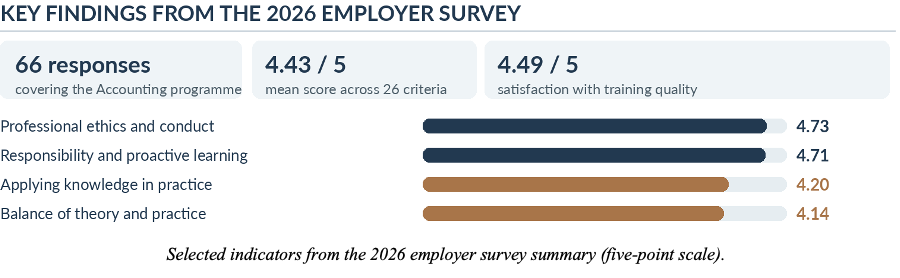
A few criteria received comparatively lower scores: the balance between theory and practice (4.14/5), the ability to apply professional knowledge at work (4.20/5), the practical value of internships (4.21/5), and work organisation and management skills (4.26/5). Although these ratings are still positive, differences across the criteria point to areas that merit attention in future curriculum improvement.
Relating Survey Findings to Programme Learning Outcomes in the Curriculum
The feedback suggests that students would benefit from more opportunities to apply what they learn to professional situations. Beyond exercises using standardised figures, students should gain experience working with accounting documents, reconciling records, identifying discrepancies and explaining results. Tasks organised around real workflows can also help them develop time management and teamwork skills.
The Accounting curriculum introduced in 2025 includes subjects such as Accounting Information Systems, Digital Accounting, Data Analytics in Accounting, and International Financial Reporting Standards (IFRS). Programme Objective PO4 and Programme Learning Outcome PLO4 address the use of accounting software, digital tools and data. These provide a basis for comparing employer feedback with course content, practical activities and assessment methods.
Curriculum review should consider not only which subjects are offered, but also how much meaningful practice students receive. Proposals to introduce more case-based exercises, use specialist software or revise internship requirements need to be assessed alongside the learning outcomes and available teaching resources.
Continuing to Collect and Use Stakeholder Feedback
Employer survey findings should be considered together with feedback from current students, alumni and lecturers. Issues raised across multiple groups can help the Faculty assess the priorities and feasibility of potential improvements. Recommendations should be grouped by theme, mapped against programme learning outcomes and considered through the Institute’s established review and approval procedures.
Going forward, the Faculty will continue engaging with employers, organising talks led by industry professionals and expanding internship opportunities. Responding to feedback is also important: the Faculty should distinguish between suggestions that can be implemented and those requiring further consideration. In this way, stakeholder input can support regular, evidence-informed curriculum review.
Linking employer feedback with teaching and learning is an important way to keep programme learning outcomes responsive to labour market needs while maintaining the curriculum’s academic foundations.