As professional requirements increasingly center on hands-on skills and digital technology, updating a curriculum can no longer rely solely on a university’s academic judgment. It must start from how employers actually use labor. In 2026, the Faculty of Finance and Accounting 1 at the Posts and Telecommunications Institute of Technology (PTIT) worked with the Center for Testing and Educational Quality Assurance to survey alumni, lecturers and employers. The surveys assessed how well the program meets real-world demands and identified areas needing further work. The results highlight the program’s strengths. They also give the Faculty a basis for adjusting course content, teaching methods and its engagement with industry, with the aim of improving training quality in line with labor market needs.
Feedback as the basis for quality improvement
At PTIT, stakeholder consultation is conducted under Decision No. 293/QĐ-HV of Feb. 3, 2026, on gathering feedback within the internal quality assurance system. Respondents include students, alumni, lecturers, staff and employers. Results are published on the Institute’s quality assurance portal, which adds transparency to the evaluation and improvement of its programs.
For the Faculty of Finance and Accounting 1, stakeholder surveys are one step in the continuous-improvement PDCA (Plan–Do–Check–Act) cycle. The Faculty collects feedback, assesses the extent to which learning outcomes are met, analyzes shortcomings and uses the findings to adjust courses, content and teaching methods in subsequent training cycles.
The approach is backed by the Institute’s 2025 Regulations on Educational Quality Assurance, which provide tools including corrective and preventive actions (CAPA), benchmarking, key performance indicators (KPIs) and quality dashboards. As a result, improvement efforts are tied to data, assigned responsibilities, deadlines and evidence of results, rather than stopping at general recommendations.
The approach is also consistent with the Standards and Guidelines for Quality Assurance in the European Higher Education Area (ESG 2015), in particular ESG 1.3 on student-centered learning, teaching and assessment and ESG 1.7 on information management. Each area for improvement is therefore considered in light of training objectives and practical requirements, allowing the Faculty to track the effect of adjustments from cycle to cycle.
Three perspectives, one shared demand: greater practical relevance
Three survey reports produced in 2026 by the Center for Testing and Educational Quality Assurance show that the Accounting program received positive ratings from alumni, lecturers and businesses alike. The results also point to areas needing further improvement, notably the balance between theory and practice, the conditions for active teaching and learning methods, and the program’s links to the professional environment.
Stakeholder survey results, 2026
| Survey group | Sample size | Key results | Areas for improvement |
|---|---|---|---|
| Accounting alumni | 124 respondents | 90.3% employed; 87.1% working in their field; 94.4% employed within six months of graduation; overall satisfaction of 4.25–4.32/5 | Ability to shorten the time needed to adapt to work: 4.13/5; theory-to-practice ratio: 4.15/5; contact with businesses: 4.19/5 |
| Faculty lecturers | 20 questionnaires | Average score of 4.59/5 across 34 criteria; 98.09% of ratings at 4–5 | Teaching facilities: 4.40/5; conditions for applying active teaching and learning methods: 4.45/5; avoidance of overlapping course content: 4.45/5 |
| Employers | 66 responses | Average score of 4.43/5 across 26 criteria; satisfaction with graduate quality: 4.49/5; willingness to hire again: 4.47/5; professional ethics: 4.73/5 | Theory-to-practice ratio: 4.14/5; ability to apply knowledge in practice: 4.20/5; practical value of internships: 4.21/5 |
The figures reflect the views of survey participants and do not automatically represent all Accounting graduates. The Faculty therefore uses the data mainly to identify trends, compare perspectives across groups and determine which issues to address first.
Besides periodic surveys, the Faculty continues to receive direct feedback from students. Student opinions on teaching were collected from 2019 to 2024. During the curriculum review, students and alumni again called for more practice time and more exposure to businesses. They also asked for talks by chief accountants and industry experts, and for more specific guidance on technology and professional practice, especially the use of accounting software, bookkeeping and the handling of real sets of source documents.
The suggestions show that learners want more than specialized knowledge. They want to turn it into skills they can use immediately in the workplace.
From survey data to priority issues
Comparing the three groups, the clearest common thread is the need to balance theory and practice. Alumni rated this criterion 4.15/5 and employers 4.14/5, and it is among the lowest-scoring of the criteria surveyed.
From the employers’ perspective, students have a solid grounding in the subject but need more training to work confidently with real source documents, reconcile payables and receivables, check invoices, file tax returns and explain figures. This matches the alumni survey, in which the criterion on shortening the time needed to adapt to a job scored 4.13/5. It calls for more simulated work scenarios and hands-on practice throughout the program.
Another issue is the conditions for quality teaching and practice. In the lecturer survey, the group of criteria on conditions for ensuring teaching quality had the lowest average score, at 4.44/5. Feedback from participating groups also points to a need for additional accounting software, financial data analysis tools and up-to-date case datasets. These are important if learners are to become familiar with business processes and technology requirements in the corporate environment.
Ties between the university and business also leave room to grow. The criterion on contact with businesses scored 4.19/5 in the alumni survey. Of 124 respondents, 11.3% said they found jobs through the companies where they interned, and 0.8% through referrals from the university. The figures suggest a need for stronger recruitment links, a wider network of partners and a more effective path from internship to employment.
On program design, lecturers rated the criterion on limiting overlap between courses at 4.45/5, while the criterion on implementing learning outcomes consistently across courses scored 4.50/5. In addition, 25.8% of alumni rated the usefulness of what they had learned as only average. The results show a need to further clarify the links among learning outcomes, course content, practical activities and assessment methods, so that each course contributes specifically to students’ professional competence.
The issues identified are therefore interlinked. More practice must go hand in hand with a review of course content. New technology tools must be tied to professional exercises. Expanded cooperation with businesses must be reflected in course design, internship organization and assessment of graduating competencies.
Improvements already under way
The Faculty has reviewed and updated the Accounting program in several phases, with two notable rounds of improvement in 2023 and 2025.
After an external evaluation in 2023, the Faculty reviewed the program’s objectives, revised learning outcomes to make them measurable, broadened the pool of survey respondents and added a program specification. In 2024, it continued surveying needs, objectives and learning outcomes in preparation for a new version of the program.
The program applied from 2025 is organized around seven groups of learning outcomes: foundational knowledge, professional skills, critical thinking, digital skills, communication, teamwork and professional ethics. New courses include Digital Accounting, Data Science and AI for Accounting, Data Analytics in Accounting and International Financial Reporting (IFRS).
The change goes beyond content to how teaching and learning are organized. The Faculty is placing more emphasis on project-based learning and simulated practice. Students are assessed on applying knowledge, solving problems and producing work, rather than mainly on recall.
Among the professional courses, Bookkeeping and Financial Statement Preparation is delivered through case scenarios and accounting software. In the final semester, students complete a four-credit graduation internship and a six-credit thesis. Course outlines in financial accounting, bookkeeping and financial statement preparation are also being updated in line with Circular No. 99/2025/TT-BTC, so that teaching reflects the corporate accounting regime currently in force.
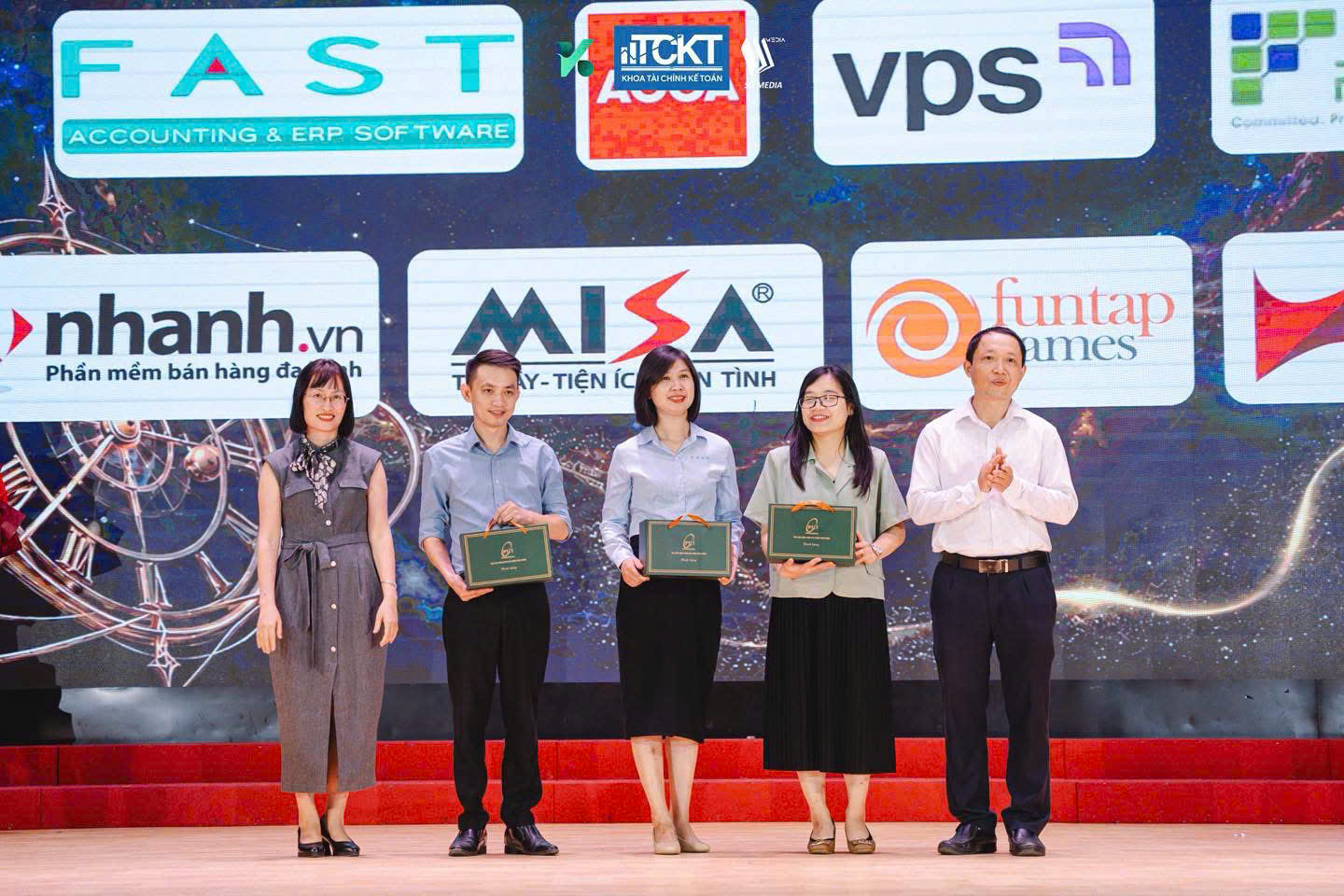
Alongside curriculum reform, the Faculty has worked to widen students’ exposure to professional practice. In 2024, it ran five free accounting practice courses for more than 250 students and provided training on FAST software for lecturers. It also held seminars with ACCA and KPMG on international standards and with MISA on applying AI in finance and accounting, as well as company visits to MISA and VPS.
Over 2022–2025, the Faculty offered 19 free courses, with 940 student enrollments by Accounting majors. The textbooks on Taxation and Accounting and on Principles of Accounting were also updated in 2025. These activities give students more opportunities to encounter new knowledge, professional tools and real workplaces.
Continuing to adjust to professional demands
Drawing on the 2026 survey results and measures already in place, the Faculty has set several priorities for the next cycle.
First, it will review its course outlines to reduce overlapping content and clarify what each course contributes to the program’s learning outcomes. The review will specify the competencies to be developed, the corresponding practical activities, the work students must produce and the criteria for assessing results. This will make the links among program objectives, teaching content and graduating competencies clearer.
On practice, the Faculty plans to increase time spent on accounting software, spreadsheets and data analysis tools. Real sets of source documents, exercises on detecting discrepancies in figures, financial reporting and tax filing will feature more heavily in teaching. Grading criteria will also be made public so that students understand what is expected, can track their own progress and can improve.
On cooperation with business, the Faculty intends to work more closely with accounting, auditing, tax advisory and banking firms to hold practice-focused seminars, develop case-based assignments and agree on internship tasks and assessment criteria. It will also draw up a priority list of specialized software and up-to-date learning materials to invest in, in order to improve practice conditions.
The surveys themselves will also be refined to capture more detailed information. The next questionnaire is expected to separate responses at three, six and 12 months after graduation, and to ask more clearly about job-search channels, types of employer and income. This will let the Faculty follow the transition from study to work more closely and give it a firmer basis for judging how well the program fits professional requirements.
Continuous improvement for sustainable training quality
For 2025–2030, the Faculty of Finance and Accounting 1 aims to raise the share of students employed in jobs related to their major to 90–95%, increase the number of international professional certificates earned by students by 15% a year and sign at least 10 memorandums of understanding with businesses and organizations. It also plans three to four professional events and seminars a year, will invest in a Fintech laboratory and will bring ERP, SAP and MISA software into the classroom.
To achieve these goals, gathering and acting on stakeholder feedback will remain important. Student input reveals the learning experience; alumni feedback shows how useful their knowledge has been on the job; lecturers’ assessments give a view of teaching conditions and methods; and employers’ comments reflect what the workplace actually demands.
When these perspectives are compared and translated into concrete action, quality assurance goes beyond assessing the current situation and becomes a driver of curriculum innovation. On that basis, the Faculty of Finance and Accounting 1 will continue to build an Accounting program grounded in professional practice, responsive to the demands of digital transformation and able to strengthen graduates’ competitiveness.