Collecting feedback from learners and stakeholders is a central activity carried out in 2026 by the Faculty of Finance and Accounting 1 at the Posts and Telecommunications Institute of Technology, in coordination with the Center for Testing and Educational Quality Assurance. By benchmarking across surveys of graduates (alumni), faculty members, and recruiting employers, the Faculty is progressively putting into practice the Standards and Guidelines for Quality Assurance in the European Higher Education Area (ESG 2015), in particular Standards ESG 1.3 and ESG 1.7.
Placing Learners at the Center and Managing Quality Data
As the Institute advances in integration and in standardizing higher education quality, the Faculty’s collection of student feedback on teaching and learning quality, together with input from faculty members and employers, goes beyond administering periodic surveys. It directly reflects two core pillars of the internal quality assurance framework under ESG 2015:
- Implementing student-centered learning, teaching and assessment: Higher education institutions are required to deliver programs that encourage students to take an active role in shaping the learning process, while ensuring that examination and assessment methods properly reflect this approach. Surveys on the learning experience, transparency of assessment, support from faculty, and the practical applicability of the Accounting program provide direct evidence for the Faculty to review and adjust its pedagogical methods.
- Implementing Standard ESG 1.7 (Information Management): Institutions must collect, analyze, and effectively use relevant information to manage programs on the basis of empirical evidence. Through the 2026 surveys, the Faculty comprehensively measured the core indicators under ESG 1.7: learner satisfaction with the program, access to learning resources and support services, graduates’ career paths, and the extent to which learning outcomes are met, as seen by faculty members and employers.
An Overview of the 2026 Multi-Dimensional Survey Results at the Faculty of Finance and Accounting
Data compiled from three 2026 survey reports of the Center for Testing and Educational Quality Assurance (Report No. 158_3/TTr-KT&ĐBCLGD dated October 9, 2026; Report No. 158_13/TTr-KT&ĐBCLGD dated October 9, 2026; and Report No. 137_16/TTr-KT&ĐBCLGD dated August 15, 2026) show positive quantitative results on a 5-point scale across all three respondent groups:
| Respondent group | Valid sample size | Average score / key indicators | Highest-rated areas | Relatively lower-scoring areas needing improvement |
|---|---|---|---|---|
| Graduates (Accounting alumni) | 124 respondents (117 graduated less than one year ago) | 90.3% employed; 87.1% working in their field of study; overall satisfaction of 4.25–4.32/5 | Enthusiastic and supportive faculty (4.40/5); guidance for internships and projects (4.39/5); faculty expertise and pedagogy (4.38/5) | Program helps shorten the adjustment period at work (4.13/5); balance of theory and practice (4.15/5); links with enterprises and employers (4.19/5) |
| Faculty members of the Faculty of Finance and Accounting | 20 questionnaires (10 from Accounting, 10 from Financial Technology – Fintech) | Overall average across 34 criteria of 4.59/5; 98.09% of ratings at levels 4–5 | Learning outcomes accurately reflect academic and professional requirements (4.80/5); readiness to take part in teaching and program improvement (4.75/5) | Teaching facilities meet requirements (4.40/5); conditions for applying active teaching and learning methods (4.45/5); no overlap in course content (4.45/5) |
| Employers | 66 responses selecting the Accounting major | Overall average across 26 criteria of 4.43/5; quality satisfaction of 4.49/5; willingness to rehire of 4.47/5 | Professional ethics and conduct (4.73/5); discipline, responsibility, and drive for self-improvement (4.71/5) | Reasonable balance of theory and practice (4.14/5); applying professional knowledge in practice (4.20/5); practical value of internships (4.21/5) |
Benchmarking of representative indicators and priority areas for improvement from the three 2026 survey reports
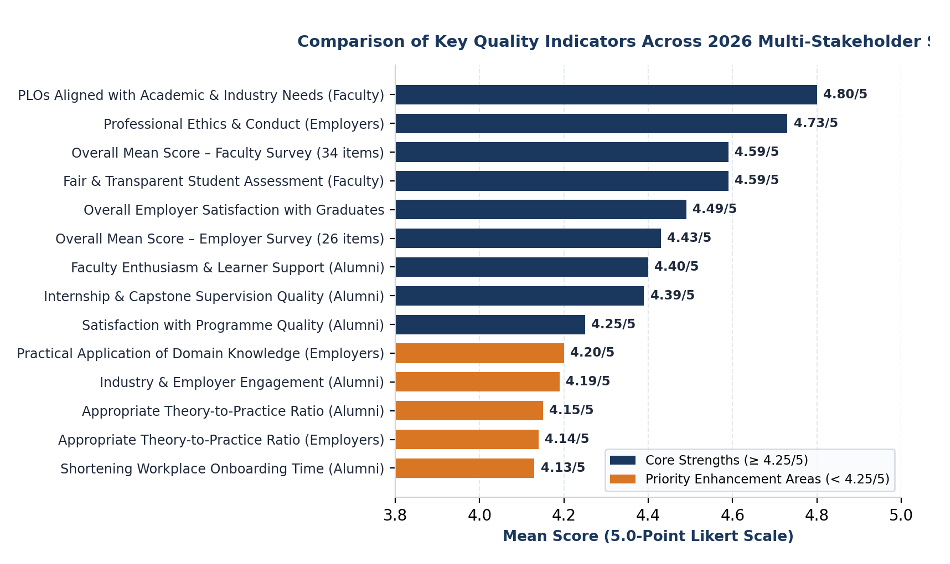
Benchmark comparison of highest-rated quality indicators and priority enhancement areas across the 2026 surveys.
Learner Feedback on Teaching Quality, Learning Conditions, and Career Outcomes
In the survey of 124 alumni of the full-time undergraduate Accounting program at the Hanoi campus, the career-path output indicators, which are the focus of the survey, produced encouraging results:
- Employment rate and time to enter the labor market: 112 of 124 respondents (90.3%) were employed, 10 (8.1%) were not yet employed, and 2 (1.6%) were pursuing further study. Notably, 79.0% (98 respondents) found work in less than three months, and 94.4% (117 respondents) were employed within six months of graduation.
- Job relevance and income: 87.1% (108 respondents) work in their field of study, mainly in domestic enterprises (79.0%, or 98 respondents). The most common income range is VND 6–10 million per month (70.2%, or 87 respondents), followed by VND 10–15 million (11.3%, or 14 respondents), under VND 6 million (17.7%, or 22 respondents), and over VND 20 million (0.8%, or 1 respondent).
- Assessment of faculty and student-centered activities: Learners gave high ratings to faculty members’ enthusiasm and readiness to help (4.40/5), their expertise and teaching methods (4.38/5), and the fairness and transparency of assessment (4.37/5). Guidance for internships and graduation projects/theses scored 4.39/5, the library and learning resources 4.32/5, and classroom and IT infrastructure 4.28/5.
- Lifelong learning needs and flexible study pathways: 67.7% (84 respondents) believe that further study helps develop their professional level, with 37.1% planning to study again after gaining work experience and 8.1% planning to do so immediately after graduation. Respondents proposed that the Institute provide scholarships (34.7%), post-study career guidance (24.2%), and flexible study schedules (22.6%).
Faculty Perspectives on the Program and Pedagogy
A survey of 20 faculty members of the Faculty of Finance and Accounting (including 16 course instructors and 4 members of the Council for Program Development and Improvement; 40% with more than 10 years of experience) shows strong consensus on the program’s academic direction:
- Learning outcomes and program structure: Vision, mission, and core values received the highest average score (4.72/5), followed by the overall assessment of the program (4.66/5) and learning outcomes (4.65/5). Faculty members affirmed that the program was developed on the basis of surveys of students, experts, and enterprises, and that it leverages the Institute’s strengths in information technology.
- Teaching methods and learner assessment (ESG 1.3): Both “Teaching methods” (4.55/5) and “Assessment of learning outcomes” (4.59/5) received 100% of ratings at levels 4 and 5. However, “Feedback on assessment results is provided to students promptly and effectively” (4.55/5) and “Conditions are favorable for applying active teaching and learning methods” (4.45/5) were the lowest-scoring items in their respective groups, indicating a need for more coordinated investment in learning materials and practice software.
Objective Assessment from Employers
Based on 66 responses from enterprises in accounting, auditing, tax consulting, banking, fintech, trade, manufacturing, and logistics, the Faculty’s graduates stand out for their professional qualities but still need to build practical operational skills:
- Strengths in attitude and professional ethics (4.62/5): Employers gave excellent scores for professional ethics and conduct (4.73/5), discipline, responsibility, and drive for self-improvement and proactive learning (4.71/5), and the ability to adapt to changing environments (4.59/5).
- The gap between knowledge foundations and practical operations (4.28/5): Although graduates’ knowledge foundation suits their job positions, and their ability to work independently and use professional tools both scored 4.38/5, the criterion “Ability to apply professional knowledge effectively in practice” scored only 4.20/5, the lowest in the professional competence group. Similarly, in the working skills group (4.38/5), skills in organizing and managing work received the lowest score (4.26/5).
Key Issues Identified from the Three Survey Reports
By cross-referencing data from all three surveys in line with information management principles, the Faculty of Finance and Accounting 1 has precisely identified five core issues to address:
The proportion of practice and the ability to adapt to real-world work remain a shared bottleneck. Both alumni and employers gave their lowest score to “Reasonable balance between theory and practice” (4.15/5 in the alumni survey and 4.14/5 in the employer survey). In addition, the ability to shorten the adjustment period at work scored 4.13/5, and the ability to apply knowledge in practice scored 4.20/5. Students have mastered the principles but still struggle to turn them into hands-on tasks such as processing real sets of documents, reconciling payables and receivables, checking invoices, filing tax returns, and explaining figures to managers.
Specialized software infrastructure and practice data have not kept pace with pedagogical innovation. In the faculty survey, the group “Conditions for ensuring teaching quality” had the lowest average score (4.44/5), within which teaching facilities scored 4.40/5. All three respondent groups recommended strengthening accounting software, financial data analytics tools, process automation, and up-to-date business case datasets.
Enterprise linkages and the effectiveness of job-referral channels need to be strengthened. In the alumni survey, “Links with enterprises and employers” scored 4.19/5. Only 11.3% found jobs through internship enterprises and 0.8% through the Institute’s referrals, while 50.0% selected “other” sources and 27.4% found jobs through friends and acquaintances. Faculty members and employers also proposed regularly adding guest lectures by industry practitioners within courses and expanding internships to an earlier stage.
The alignment of learning outcomes and overlap between courses need to be reviewed. The faculty survey identified the two lowest indicators in the program group as “Course content is free of duplication and overlap” (4.45/5) and “Learning outcomes are appropriately implemented across courses” (4.50/5). In addition, with 25.8% of alumni rating the usefulness of the knowledge they gained as “average,” the Faculty needs to clarify the matrix linking learning outcomes, teaching content, practical assignments, and assessment methods.
The survey instruments should continue to be refined and detailed to deepen analysis. Alongside the positive results, the reports suggest refining the survey forms in future cycles so that the data becomes more detailed and closer to reality. For the alumni survey (124 responses), distinguishing more clearly between post-graduation milestones (3, 6, and 12 months) and expanding the pre-defined options for job-search channels, type of employer, and income structure would help the Faculty track each cohort’s career transition more closely. For the employer survey (66 responses) and the faculty survey (20 questionnaires from the two programs of Accounting and Financial Technology – Fintech), adding detailed classification by job position, specialized professional area, and the characteristics of each training program would provide a better basis for benchmarking and updating courses.
Directions for Improving Teaching and Learning Quality in the Coming Period
On the basis of these empirical findings, the Faculty of Finance and Accounting and the Center for Testing and Educational Quality Assurance have set out a coordinated improvement roadmap to close the quality assurance cycle in line with ESG 1.3 and ESG 1.7:
Review the learning outcomes matrix and eliminate course overlap: Conduct a comprehensive check of course syllabi, course sequencing, and the connection between foundational and specialized knowledge, clearly defining for each course what competencies it builds, where students practice, what products they produce, and by what criteria they are assessed.
Renew teaching, learning, and assessment methods toward practical application: Increase practice time on accounting software, spreadsheets, and data analytics tools; bring real document sets, exercises on detecting data discrepancies, financial statement preparation, and tax filing into lectures. Faculty members will publish clear grading rubrics covering accuracy, compliance, data security, and timely feedback so that learners can take the initiative in improving their competencies.
Expand enterprise cooperation and upgrade learning resource infrastructure: Work closely with accounting, auditing, and tax consulting firms, banks, and other enterprises to organize practical seminars, assign case-based exercises, and standardize internship tasks and assessment criteria. At the same time, draw up a priority list for investment in specialized software and up-to-date learning materials.
Standardize the survey data collection and analysis system: Redesign next cycle’s questionnaires to separate the 3-month, 6-month, and 12-month post-graduation milestones precisely, and detail the categories of employing organizations, job-search channels, income levels, and the majors assessed by employers. Every improvement item will be assigned a lead unit, a completion deadline, and specific supporting documentation so that trends can be tracked from year to year.